¶ New Team Resources
Welcome to the Collegiate Robotic Football Conference!
This page of resources is designed to help new teams understand the sport, the competition structure, and the recommended path to getting on the field as quickly as possible. Please note that nothing here is mandatory (except the parts that directly reference the League Rulebook). This is a suggested starting point and a way to quickly get a working bot for your first combine, but please feel free to make modifications as you go and experiment withdifferent options.
You do not need prior experience with robotic football to get started. Many successful teams began by building a single standard robot and iterating from there.
¶ Background of the Sport
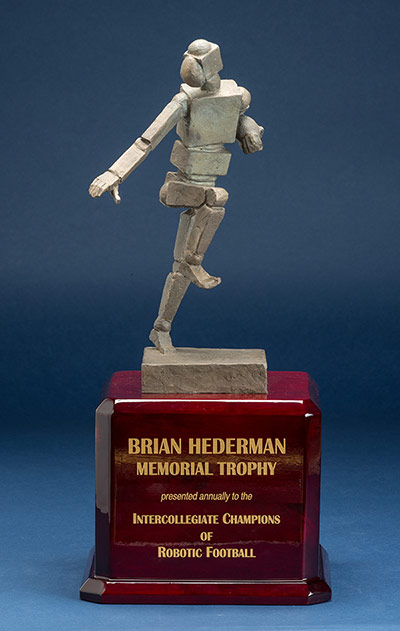
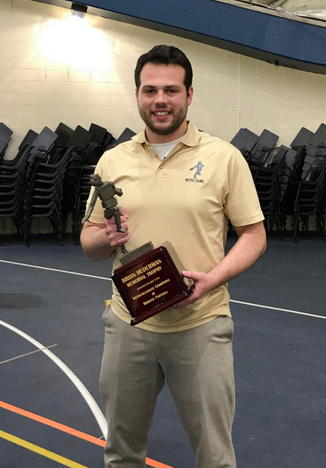
The Collegiate Robotic Football Conference (CRFC) unites universities nationwide to compete in robotic football, a sport created in memory of Brian Hederman, a Notre Dame student who died in a car accident in 1995. Initially, a memorial fund in his honor was intended for scholarships, but in the early 2000s Brian’s father was inspired by a sketch Brian had drawn of a robot football player. This led to the idea of a robotic football competition that would serve as a lasting and engaging memorial while showcasing engineering innovation. With the help of colleagues and support from Notre Dame, the memorial funds were redirected to establish a national intercollegiate championship. The winner receives the Brian Hederman Memorial Trophy, designed using Brian’s original sketch, which also lives on in the modern CRFC logo symbolizing both the sport’s technological future and its meaningful origins.
More about our history can be read here.
¶ Rules of the Sport
The CRFC reviews and updates the official rules of the game every summer. These rules define how robotic football is played and ensure fair, safe, and consistent competition across all participating universities. New teams are strongly encouraged to become familiar with the Rulebook early, as it guides every aspect of robot design, gameplay, and competition. These rules can be found here.
At a high level, the CRFC competition is modeled after an 8-on-8 American football match, with teams fielding robots that they fully design and build. Gameplay closely resembles traditional NCAA football, including snapping the ball, handing off to running backs, passing, and executing kicks such as field goals, punts, and onside kicks. This structure allows teams to explore a wide range of engineering challenges while competing in a familiar and exciting sport.
Each team is expected to develop a full roster of robot types over time, including a Standard Robot, Quarterback, Center, Running Back, Wide Receiver, and Kicker. For new teams, the recommended starting point is the Standard Robot, which can be used on the offensive line or defense. Building a reliable Standard Robot allows teams to learn the fundamentals of CRFC systems, rules, and gameplay before progressing to more complex robots like Quarterbacks and Kickers.
All CRFC robots must meet specific design and safety requirements as outlined in the rulebook. All teams are expected to read these rules and comply with all design and safety requirements. New teams should pay special attention to the following core design and safety requirements:
- Standard robots must fit within a 16” x 16” x 24” box (see rules for specialty robots).
- All robots must have their baseplate 3” above the ground.
- Baseplates are required to be made from ” HDPE.
- Standard robots must weigh less than 30lbs (see rules for specialty robots).
- Specific materials are defined for the bumpers.
- Conference Tackle Sensors are provided that must be installed in all ball-carrying robots.
- Particularly bright LEDs are required on all 4 sides of the robot.
- The maximum voltage batteries allowed are 24V.
- Robots must be colored to match their team’s designated uniform colors.
CRFC hosts two major competitive events each year: the Fall Combine and the National Championship Tournament. The Fall Combine is designed specifically with developing and new teams in mind. Teams that have not yet completed a full eight-robot roster can compete in individual events to earn prizes and work toward qualification for the National Championship. During the National Championship weekend, additional events are hosted for teams that are still building towards a full roster. These events allow newer teams to gain competition experiences, test their designs, and learn from established teams.
This onboarding kit is intended to guide new teams through the process of building their first robot and preparing for their initial Fall Combine, helping them taking their first steps into the CRFC competition with confidence.
¶ Design Concepts
There are many factors to consider when designing a robot from scratch. In this section we're going to outline a few of the main areas we have considered for the Starter Robot, but as you build and compete, you will discover many optimizations to implement on your robot.
- Shell Material
- Motors and Motor Controller
- Wheels
- Batteries
- Microcontroller
- Remote Controller
- Other Misc. Hardware
- Tackle Sensor
- CAD
- Code
¶ Starter Bot
¶ Bill of Materials
A Bill of Materials (BOM) is a structured list of all the parts, assemblies, and materials required to build a system. It typically includes each item’s name or description, quantity, and often additional details such as part numbers, suppliers, and cost. The BOM serves as a single source of truth for what is needed to assemble, maintain, and reproduce a design, and it helps teams plan purchases, track inventory, and understand overall project cost.
Below is the Bill of Materials for the Starter Robot, which lists all of the components required to build the standard robot.
¶ Tutorials
¶ Driving
When operating your robot the diagram below will inform you of which buttons are currently mapped in this starter code you’ve been provided with. Feel free to adjust what each button does to your liking and begin to map unused buttons to wherever your creativity takes you!
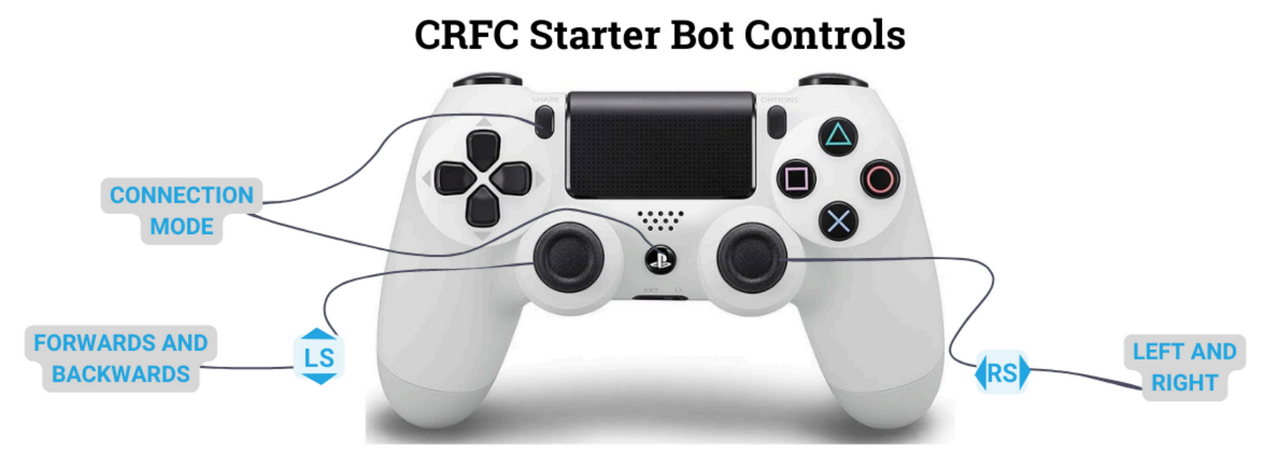
With the starter bot code, the controller needs to be paired to the robot after it powers on. When disconnected, the LED on the Pico W will be periodically flashing. Simultaneously press and hold the PlayStation button and the Share button to send the controller into pairing mode. The Pico W is looking for controllers to connect to and when it finds the controller in pairing mode it will connect. The Pico W LED will change to solid when the connection is made. When connected, the Pico W then can process the button presses and control inputs made to the controller. To drive the robot forward and backwards, the left stick can be used. To steer left and right or rotate in place, the right stick can be used. These are the only controls built into the current control code, but more can be added by modifying the code.
It often takes time to master the control of a robot so don’t forget to take some time to head to a gym on your campus and get some practice in driving around. We highly recommend setting up some of the Combine Drills according to the Events Layout document. Practice running through all the events you can to prepare for the Fall Combine and to find new areas of improvement that should attempt to tackle next in your design process.
¶ Next Steps
¶ Testing
“A Factory Acceptance Test (FAT) is a process in which a manufacturer tests a machine or system before it is delivered to the customer. The purpose is to ensure that the machine or system meets the requirements that were ordered by the customer.” Factory Acceptance Tests are a very important aspect of any engineer’s career. These are critical to the success of any project and ensure that machine will achieve what it has been set out to do.
Every project you take on in Robot Football should conclude with an FAT. In this you will want to test all functionality as you designed it to ensure that what you built achieves the goals for which you designed it. Below is a basic FAT that you should run on your completed Starter Bot to ensure that it was built effectively:
- Does it fit within 16” x 16” x 24”?
- Is the centerline of your bumper 3" + or - 0.2" above the ground, all the way around?
- Does it weigh less than 30lbs?
- Does it power on?
- Do the lights turn on? Are they highly visible from all 4 directions?
- Does a solid kick of the robot trigger the tackle sensor and thus turn the robot red?
- Does the Bluetooth controller connect and stay connected?
- Do the wheels properly react to the controller?
- Do both wheels effectively operate both in the forward and reverse directions?
- Does the robot run at a speed of at least 10 ft/s?
If any of these tests fail, begin to troubleshoot back through this document to look for anything that may look different. Use your creativity as well as you try to problem solve what might be going on.
¶ Ideas for Future Improvement
This guide outlines the build of a VERY basic standard base- there is a lot of room to go from here! We encourage you to now go improve upon this or start from scratch using what you’ve learned and create an entire team of robots, specialized for their positions on the field! Standard Bases make great lineman, but consider how to customize for a Center to hand-off the ball, a Quarterback to pass, Kickers, Receivers, etc! Below are some great strategies for troubleshooting and iterating on your designs:
¶ The Five Whys Technique
The 5 Whys technique is a problem-solving method used in engineering and other fields to identify the root cause of a problem. By repeatedly asking the question "Why?" (typically five times), you can move beyond the symptoms of the problem to uncover the underlying cause. Here’s a step-by-step explanation:
- Identify the Problem: Clearly state the problem you are trying to solve. This is the starting point for the 5 Whys analysis.
- Ask "Why?": Ask why the problem occurs and write down the answer.
- Repeat: For each answer given in the previous step, ask "Why?" again and write down the answer. Continue this process, typically five times, until you reach the root cause of the problem.
- Determine the Root Cause: The last answer should point to a process or systemic issue that is the root cause of the original problem.
- Implement Corrective Actions: Once the root cause is identified, develop and implement corrective actions to prevent the problem from recurring.
Ex. Problem: The machine stopped working.
- Why did the machine stop?
- Because it overheated.
- Why did it overheat?
- Because the cooling fan failed.
- Why did the cooling fan fail?
- Because it was not getting enough power.
- Why was it not getting enough power?
- Because the wiring was faulty.
- Why was the wiring faulty?
- Because it was not properly maintained.
Root Cause: Lack of proper maintenance.
By addressing the root cause (improving maintenance practices), the likelihood of the machine overheating again is reduced. This technique can be useful when parts of a robot break or are not acting properly. Learn from failure and improve the design.
¶ Alumni Testimonials
Congratulations! You are now ready to venture out into the world of robot football to innovate and compete to your heart’s content. Before you go though, here are some words of advice from some of the alumni who compiled this manual.
 |
Alex Buch Technical Program Manager at Amazon Robotics Much like life, engineering is a team sport. Robotic football is an awesome supplement to classroom engineering work and provides the opportunity to hone skills like project management, issue triage, and teamwork (especially across disciplines!) I use what I learned in robot football every single day in my job, and these soft skills are what I look for in interviews. Best advice I can give is to stay organized and remember you’re all on the same team, working towards the same goal. You might make some lifelong friends along the way too! |
| Jake Plocher Mechanical Design Engineer at TAIT Everytime an opportunity comes your way, at least take a shot. With Robot Football, look for opportunities to flesh out a new concept design, to talk to other students or alumni you haven’t met yet, or even to build skills in other areas that might not be your major or your strong suit. Whether or not you see immediate success at each opportunity, you will look back in a few years and see how much you grew from every shot you took. |
 |
 |
Cara Ravasio Biomedical Engineering PhD Candidate at Boston University Experiential learning opportunities like Robotic Football will teach you more about how to be an engineer than any of your classes or homework assignments. And it is also just so much more fun! Even though I don't do much hard-core electrical engineering anymore, I use the skills I developed during Robotic Football everyday, and some of my closest friends are from this club. |
| Maggie James Mechanical Design Engineer at TAIT Not only did I make lasting friendships in the Robotic Football club, but I gained valuable hands-on experience that I didn’t find in most of my Engineering classes. I also got the opportunity to work through a project from start to finish, gaining experience working with budgets, building something that I had designed, troubleshooting issues, and working on a team. The creative problem solving skills I gained from joining RFC are still valuable to me today in my post-grad life, both inside and outside of the office. |
 |
 |
Justin Buettner Manufacturing Engineer at Hendrickson Robotic Football was one of the best things I was involved with during college. It helped me to develop my engineering skills, discover new hobbies, and develop my leadership abilities. I learned engineering practices that weren’t taught in class (or were taught in classes that I slept through) like iterative development, design for manufacturing, and design for assembly. Robotic Football allowed me to work with engineers from other disciplines and see things like programming, wiring, and soldering that I never would’ve seen in my Mechanical Engineering classes. I had the opportunity to learn how to program and run CNC machines. I now have my own CNC router in my garage, and I use it to make fun projects (like this starter bot). I was able to learn and grow as a leader by coaching the team and leading weekly practices. And through it all, I made a lot of great friends that I still am close with even years after graduating. |
| Eddie Hunckler Senior Project Engineer at DMC Robotic Football provided a great way to practically apply the engineering concepts that I was learning in class when I was in college, and I hope that it will provide that for you as well! When working in the lab before the competition, you get the design and manufacturing skills. On the sidelines, you develop quick diagnostics skills. I have found over the years that the most difficult issues are often resolved by going back to the fundamentals, building up from there, and challenging assumptions along the way. Don’t be afraid to use your multimeter! |
 |
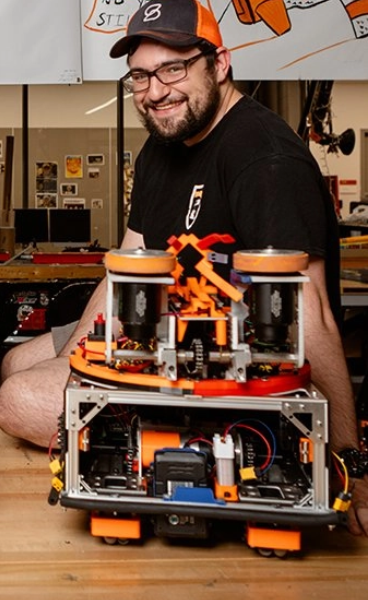 |
Aaron Smith Automation Engineer at AMT Joining a Robotic football club is great for new engineers that still want to figure out what they want to do for their career. You get to experience so many different types of engineering in a real world setting. With friendly competition of other colleges, they are always pushing each other to make new designs and achievements in the robotic football world. You make great friends and learn so much. I was able to use a lot of skills for my job today thanks to the club. |