¶ Design: Microcontroller
When picking a microcontroller to use for a robot, there are a variety of considerations. The primary considerations for this design were finding a capable microcontroller that came in an easy-to-use form factor that would be available for purchase for many years to come. Additionally, it was important that the microcontroller platform was inexpensive and feature rich. The platform needed to include sufficient flash memory for the simple application as well as support future expansion. The peripheral set on the microcontroller needed to also support a wide variety of motor control possibilities and sensor feedback using interfaces like timers and pulse-width modulation (PWM). Additionally, if the platform included a wireless connection for the controller, that would be a bonus!
The Raspberry Pi Pico W is a low-cost embedded platform that is built around the RP2040 microcontroller that includes an onboard wireless module capable of Bluetooth and WiFi communication. It has an integrated USB port for facilitating programming the device. It also has a variety of common peripherals that can be used for controlling a robot. In this case, the peripherals of interest are PWM peripherals for establishing the motor drive speed and an assortment of inputs and outputs for enabling and controlling the motor direction. Other peripherals like SPIs, I2Cs, UARTs, and ADCs can be extremely useful for interfacing with sensors and actuators for future robot feature expansion.
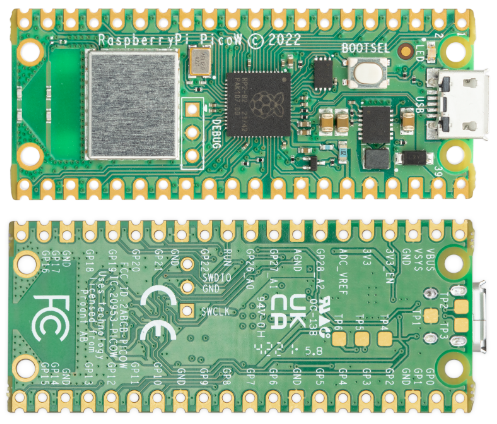
The Raspberry Pi Pico W Rev3 Board[1]
This module is a standard form factor that is being produced by the Raspberry Pi Foundation alongside the RP2040 module. Because of this, there are a variety of common breakout boards that can be used with this module. Some of these have integrated motor controllers, sensors, power supplies, and more. This design uses a simple screw terminal breakout for the Raspberry Pi Pico because it allows for future flexibility in selection of components for the robot platform. Teams could also design their own custom PCBs built around a module like the Raspberry Pi Pico to simplify the wiring in their robot.
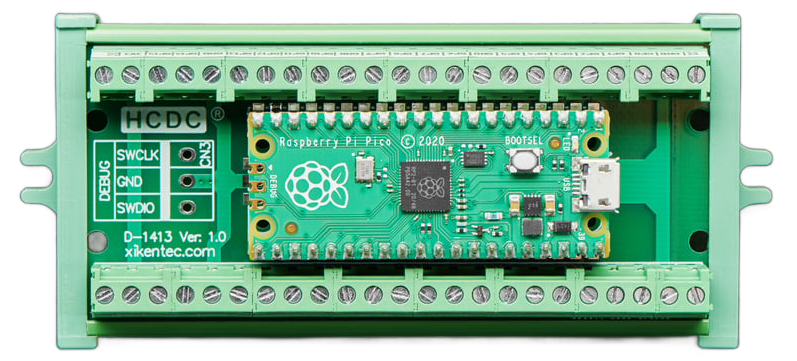
Adafruit Screw Terminal Breakout for Raspbery Pi Pico[2]
¶ References
Image taken from https://datasheets.raspberrypi.com/picow/pico-w-datasheet.pdf ↩︎
Image taken from https://www.adafruit.com/product/5095 ↩︎