¶ History of the Collegiate Robotic Football Conference
¶ Origins and Inspiration
The Collegiate Robotic Football Conference (CRFC) finds its roots in both a deeply personal and creative origin. In July 1995, University of Notre Dame engineering student Brian Hederman tragically died in a car accident during the summer between his freshman and sophomore years. In the aftermath, friends and family raised a memorial fund in his honor, initially intended to support scholarships.
Years later, Brian’s father, Bill, rediscovered a sketch Brian had made in 1993 of a robot football player. Inspired by this image, he saw an opportunity for something far more memorable than a static scholarship: a nationwide collegiate competition that would combine the thrill of football with the challenges of engineering. Working with Notre Dame alumni Skip Horvath and Vince Cushing, he developed the concept for an intercollegiate robotic football conference. Notre Dame shifted a significant portion of the memorial fund to help launch the initiative.
The result was the creation of the Brian Hederman Memorial Trophy, designed in collaboration with sculptor Thomas Marsh and inspired by Brian’s original sketch. This trophy remains the centerpiece of the conference’s competitive tradition and its logo, a visual encapsulation of the sport’s history and future.
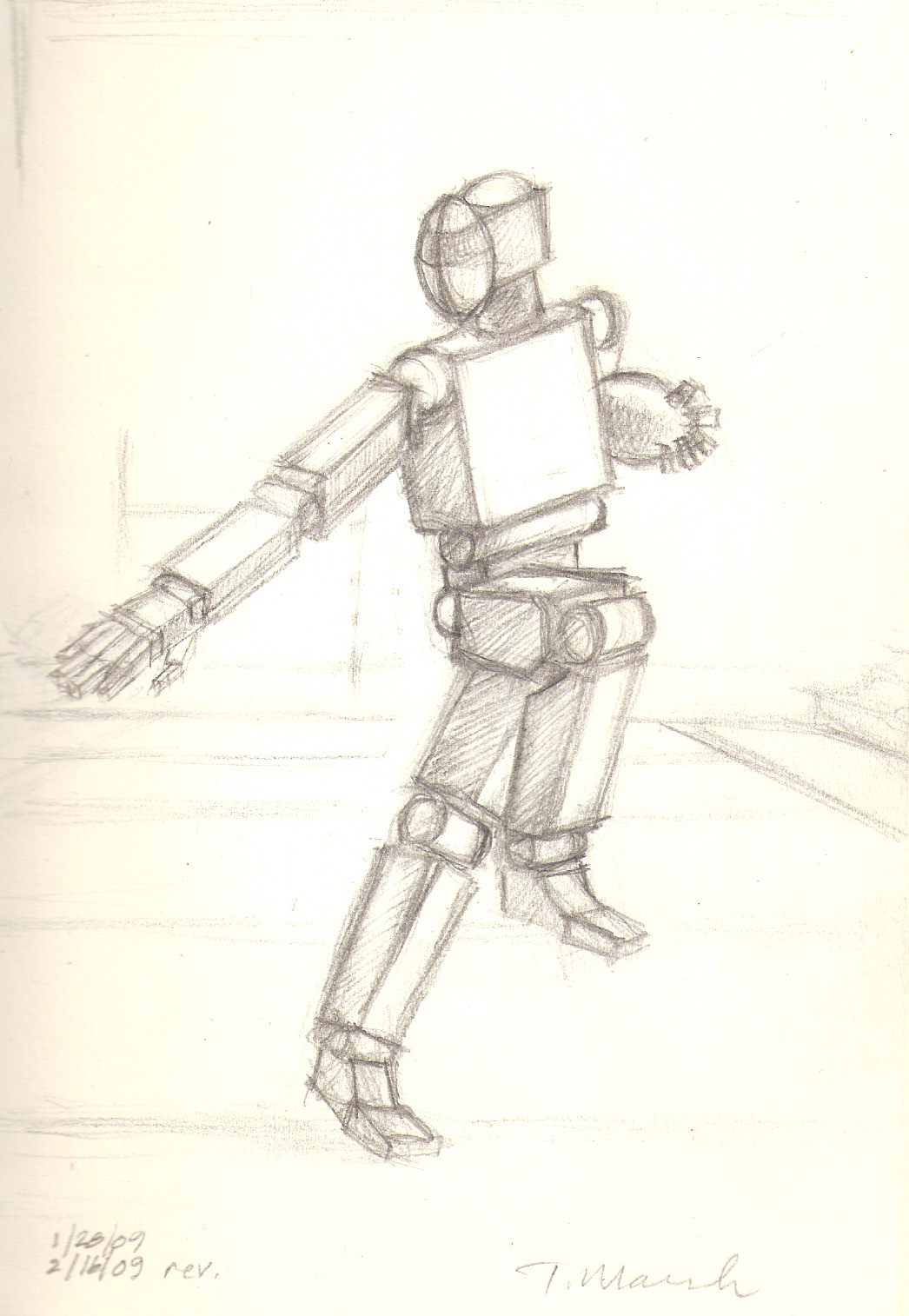
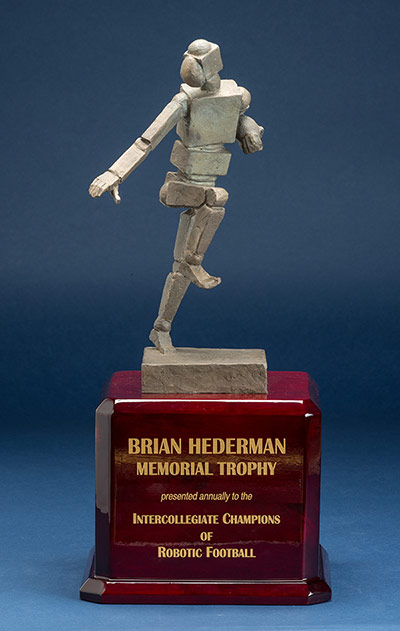
Original Sketch Next to the Brian Hederman Memorial Trophy
¶ From Concept to Competition
The first tangible steps toward robotic football took place at the University of Notre Dame around 2007, where faculty and alumni began exploring how Brian’s idea could be translated into an educational experience. Rather than creating a one-off demonstration, the goal was to build a repeatable, student-driven activity that could live within an academic environment.
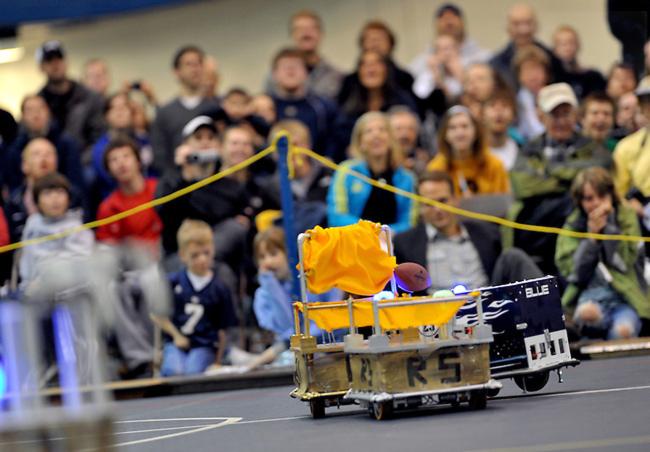
Early efforts were modest and exploratory. Students worked within design courses and independent projects to determine whether robots could realistically emulate the structure of American football. These early efforts tested the limits of mechanical design, remote control systems, and teamwork, setting the technical foundation for the formal competition. What emerged was not just a technical challenge but a compelling educational model: students working in teams, designing under constraints, iterating their design rapidly, and presenting in a public setting.
https://www.youtube.com/watch?v=lQZ3MOgf9xM
¶ Institutional Support and Early Leadership
As the concept matured, faculty leadership at the University of Notre Dame played a crucial role in transforming robotic football from an idea into a sustained academic endeavor. Engineering faculty recognized that the project aligned well with project-based learning goals, particularly systems thinking, collaborative practice, and iterative design.
By anchoring early robotic football efforts within formal coursework and student projects, the initiative gained legitimacy and continuity. Faculty involvement helped ensure that the competition remained educationally grounded while still allowing students significant creative and organizational freedom. This balance between structure and autonomy became a defining characteristic of the CRFC as it evolved.
At the same time, alumni involvement remained central. The continued engagement of Brian Hederman’s classmates helped guide the long-term vision of the conference, ensuring that the project stayed true to its memorial origins while expanding its reach and impact.
¶ Formalizing the Conference
As interest grew beyond a single campus, it became clear that robotic football needed a formal organizational structure. The Collegiate Robotic Football Conference was established in 2012 to provide consistency, continuity, and collective stewardship of the competition.
Rather than modeling itself after traditional athletic conferences, the CRFC was intentionally designed as a collaborative academic organization. Its purpose was not only to host competitions, but to foster cooperation among institutions, to share lessons learned, and to collectively shape the future of robotic football. From the start, the conference was intended not just as a technical challenge but as an educational framework that would complement classroom learning with real-world engineering practice.
This period marked an important transition: robotic football was no longer a single-university experiment, but a coordinated intercollegiate effort with a defined identity, shared mission, and growing community. The link below points to a 2012 ASEE conference paper describing the original formation of the conference and it used as a senior engineering capstone project.
- Robotic Football: An Inter-University Design Competition Experiment Dr. John-David S. Yoder, ONU, Dr. James P. Schmiedeler, ND, Dr. Michael Milo Stanisic, ND
¶ Expanding Beyond Notre Dame
With the conference framework in place, other universities began to adopt robotic football programs of their own. The appeal was double-sided: the competition offered a compelling public-facing showcase for engineering programs, and it provided students with an immersive, team-based design experience unlike most classroom projects.
As new institutions joined, the CRFC evolved organically. Each program brought its own academic culture, resources, and student perspectives, contributing to a richer and more diverse community environment. Importantly, the CRFC supported incremental participation, allowing programs to grow over time rather than requiring full-scale teams from the outset.
This approach helped lower barriers to entry and reinforced the conference’s emphasis on education, sustainability, and engagement rather than short-term success.
https://www.youtube.com/embed/TalQWEARU08?si=xn_TIibmw8LeRgIF
¶ A Unique Place in Engineering Education
From its early years onward, the CRFC has occupied a distinctive space within collegiate engineering. Robotic football combines the familiarity of a traditional sport with the open-ended complexity of a large-scale engineering project.
-
For students, participation extends far beyond technical design. Teams must organize their work, manage schedules and budgets, communicate across disciplines, and perform under public scrutiny. These experiences mirror the realities of professional engineering practices and help explain why many participants remain involved across multiple years.
-
For the broader community, CRFC events serve as a visible demonstration of what student engineers can accomplish. Games and related events function as outreach opportunities, connecting engineering programs with audiences who might otherwise have limited exposure to the field.
¶ Continuing the Original Vision
The Collegiate Robotic Football Conference exists to ignite imagination, serve students, and create collaboration through the dynamic platform of Robotic Football.
Inspired by the innovative spirit of Brian Hederman, we aim to transform bold ideas into real-world engineering challenges that push the boundaries of creativity, technology and collaboration. The CRFC serves as a national stage for students to apply classroom knowledge, grow as teammates and leaders, and prepare for success in an increasingly complex world.